Amber Fort, Jaipur — The Complete Visitor's Guide
The hilltop palace-fort the Kachwaha kings ruled from before Jaipur city existed. Here is everything worth knowing before you walk through the Suraj Pol — written by people who drive guests here every week.
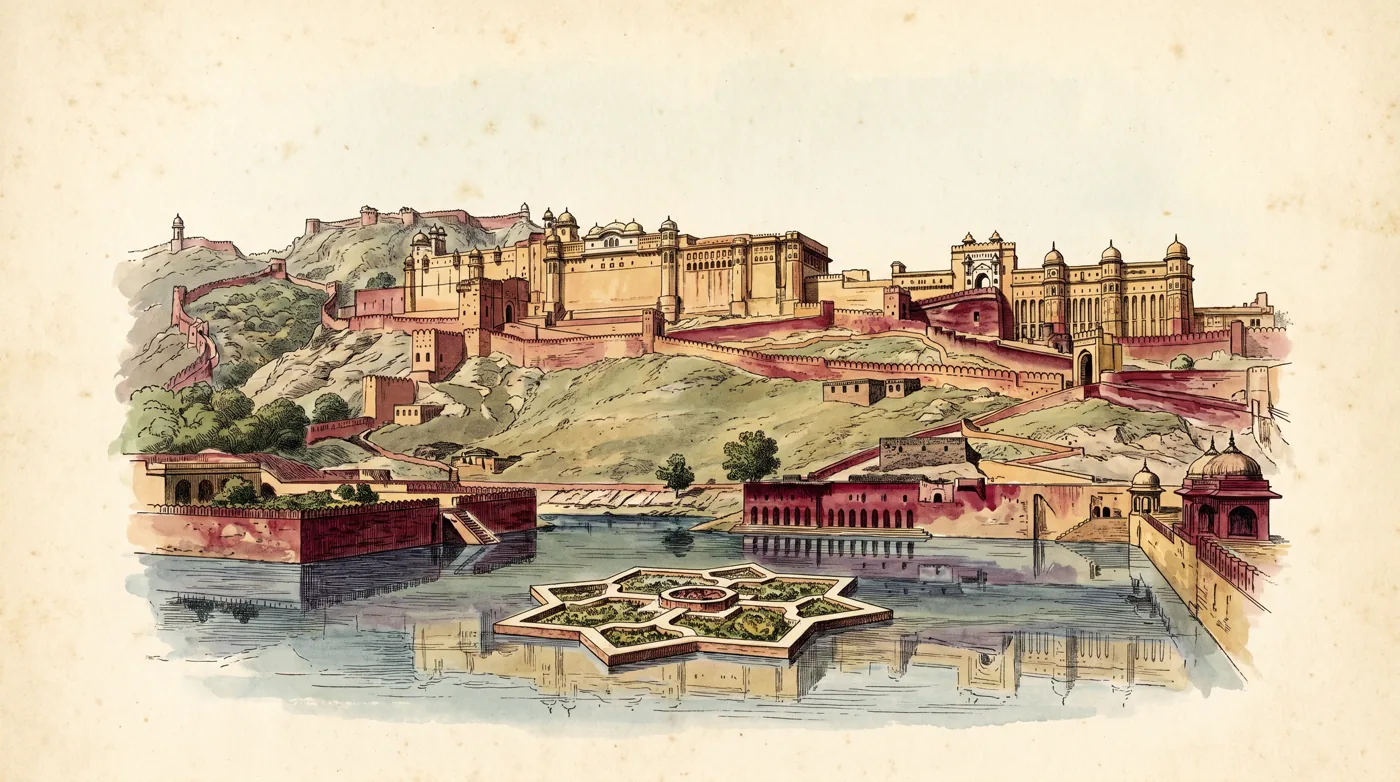
Amber Fort (also spelled Amer Fort) is a 16th-century hilltop palace-fort 11 km north of Jaipur, built in 1592 by Raja Man Singh I and expanded over the next 150 years. It was the capital of the Kachwaha Rajputs before Jaipur city was founded in 1727, and is part of the UNESCO-listed Hill Forts of Rajasthan. It is the single most-visited monument in Jaipur.
- Timings: 8:00 am – 5:30 pm daily; separate night viewing 6:30 – 9:15 pm.
- Entry: ₹100 for Indians, ₹500 for foreigners (the ₹300/₹1,000 composite ticket also covers it plus 7 other sites for 2 days).
- Time needed: 2–3 hours for the four courtyards at a comfortable pace.
- Best time to arrive: 8:00 am sharp — tour buses land around 9:30 and the courtyards change completely.
- How to reach: 11 km from the city (~30 minutes by cab); no metro or direct train.
- Don't miss: Sheesh Mahal (the mirror palace), Ganesh Pol, and the Kesar Kyari garden floating in Maota Lake.
Most people arrive at Amber Fort, photograph the Ganesh Pol, buy a fridge magnet and leave in forty minutes. That is a waste of a fort that took four generations of kings to finish. Amber is not one building — it is four courtyards stacked up a hillside, each one built by a different ruler for a different purpose, and once you know which is which, the whole place reads like a story instead of a maze. This guide walks you through it the way our drivers and guides do it: the right entrance, the right order, and the corners the crowd walks straight past.
Heritage plates
Hand-coloured artwork commissioned for this guide, in the style of the 19th-century travel plates that first carried Amber Fort to the world.
A short history — why the fort is here at all
Long before Jaipur existed, this valley was the seat of the Kachwaha Rajputs. The place takes its name from Amba — the mother goddess — and a modest fort stood on this ridge from the 11th century. What you see today began in 1592, when Raja Man Singh I — one of Emperor Akbar's most trusted generals — started building a palace worthy of a man who commanded Mughal armies. That Mughal connection is the whole aesthetic key to Amber: it is a Rajput fort wearing Mughal clothes, and you can see the two styles arguing with each other in every courtyard.
His successors kept adding. Mirza Raja Jai Singh I (mid-1600s) built the showpieces — the Sheesh Mahal and the Ganesh Pol. Sawai Jai Singh II made the final additions before doing the unthinkable in 1727: he abandoned the fort entirely and founded a brand-new planned city 11 km south, which he named after himself — Jaipur. Amber was left behind, which is exactly why it survived so intact. Nobody modernised it.
The four courtyards — what you are actually looking at
Amber climbs. You enter low and walk up, and each level was more private than the last. Understanding this sequence is the difference between wandering and actually seeing the place.
The story, in five dates
A small fort of the Meenas, later taken by the Kachwaha Rajputs, stands on this ridge.
Raja Man Singh I — Akbar's general — begins the palace-fort you see today.
Mirza Raja Jai Singh I builds the Ganesh Pol and the Sheesh Mahal.
Sawai Jai Singh II abandons Amber and founds the new planned city of Jaipur.
Inscribed by UNESCO as part of the Hill Forts of Rajasthan.
Inside Amber Fort — what to see, in order
Jaleb Chowk — the first courtyard
You come in through the Suraj Pol (Sun Gate), and this vast parade ground is where returning armies displayed their war booty — for the queens to watch from latticed windows above without being seen. The stables were here; today it is where the cars and the crowd collect.
Sila Devi Temple
Tucked off Jaleb Chowk, up a small flight of silver-doored steps, is the Kachwaha family's temple to Sila Devi — an incarnation of Kali that Man Singh brought back from a campaign in Bengal. The silver doors are worked with figures in relief and are genuinely beautiful.
Diwan-i-Aam — the second courtyard
The Hall of Public Audience: a raised platform of 27 pillars where the king heard commoners' petitions. Look closely at the pillar capitals — elephant heads carved in the Rajput manner, holding up arches that are pure Mughal.
Ganesh Pol — the gate everyone photographs
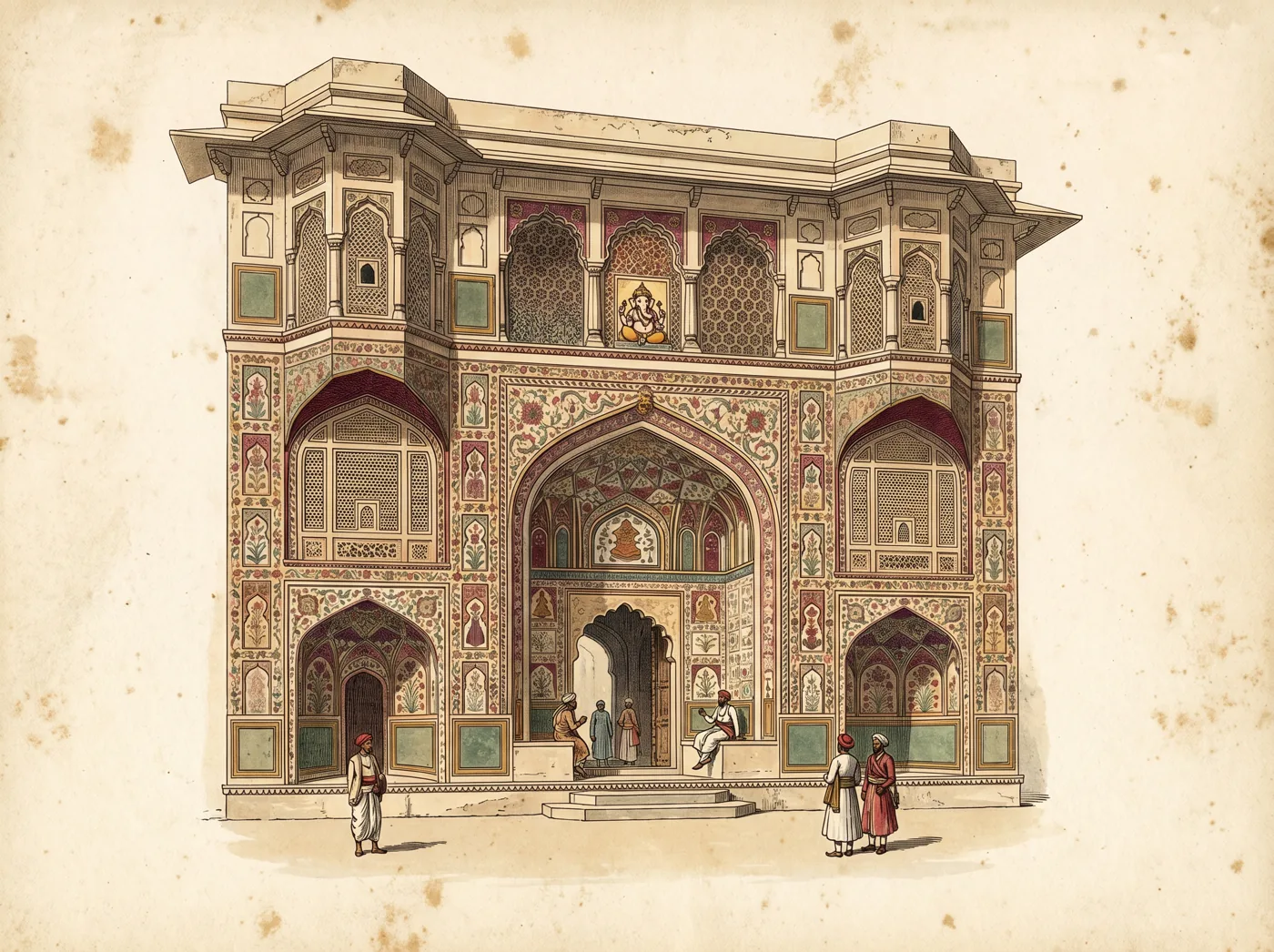
The three-storey painted gateway into the private palace, built by Jai Singh I around 1640, and probably the most photographed doorway in Rajasthan. Frescoes in mineral colours cover it top to bottom, with Ganesh above the arch. Above it sits the Suhag Mandir — latticed galleries where the royal women watched ceremonies below, unseen.
Sheesh Mahal — the mirror palace
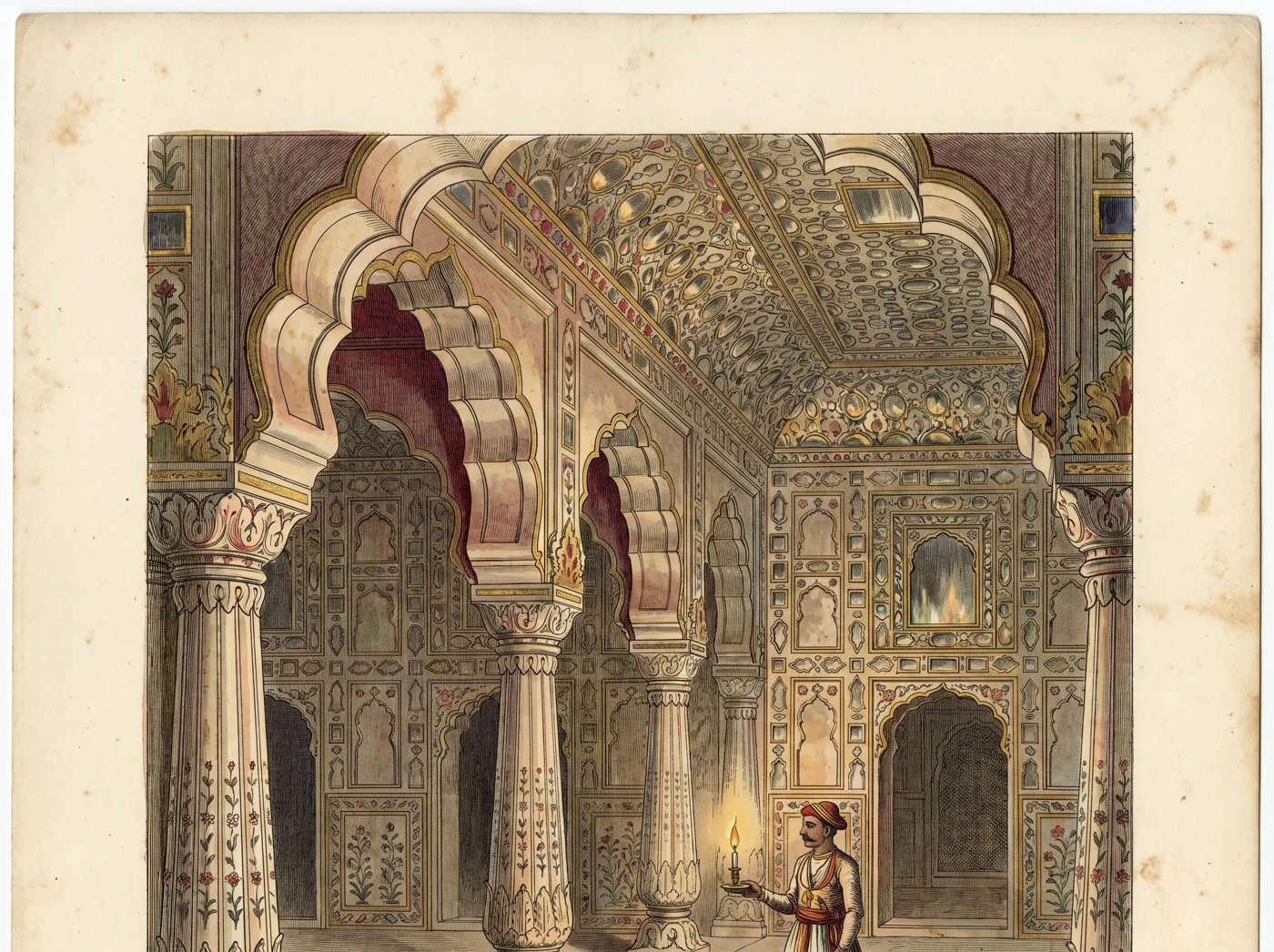
The reason Amber is famous. The Jai Mandir's walls and ceiling are inlaid with thousands of convex mirror pieces and coloured glass imported from Belgium. The engineering is the point: the mirrors were cut and angled so that a single candle flame reflects into a ceiling of stars — a king could light his chamber with one candle and sleep under a night sky.
Sukh Niwas — the air-conditioned room from 1640
Directly opposite the Sheesh Mahal across the garden, this pleasure-hall had a genuine climate-control system: water from the Maota was channelled in cascades down a carved marble chute and through the room, while wind blowing over it cooled the whole chamber. Sandalwood doors, and it worked in 45°C summers.
Aram Bagh & the Charbagh garden
The geometric Mughal-style garden sitting between Sheesh Mahal and Sukh Niwas, on a raised terrace — a formal char-bagh (four-part garden) that acted as the palace's cool green heart.
The Zenana — Man Singh I Palace (fourth courtyard)
The oldest part of the complex and the most human. Man Singh had twelve queens, and this courtyard has twelve identical apartments arranged around it — each with its own staircase, so the king could visit one without the others knowing. A shared corridor connects them all.
Maota Lake & Kesar Kyari Bagh
The lake below the fort was its water supply, and floating in it is the Kesar Kyari — a star-shaped garden where saffron was once planted (it did not take to the climate; the beds remain). This is the view in every postcard of Amber.
Amber Fort ticket prices 2026
Prices are the current published rates and are revised from time to time — treat them as a guide and confirm at the counter. If you plan to see even three of the composite-ticket sites, the composite pays for itself immediately. Buy it at your first monument, not at Amber specifically.
How to reach Amber Fort
By cab (recommended)
11 km from the city centre, about 30 minutes up the Delhi–Amer road. A cab can park at the base and wait — which matters, because there is no easy transport back down at closing time. Our full-day sightseeing cab is ₹1,799 and starts here at 8 am by design.
By auto-rickshaw
₹400–600 return from the old city if you negotiate, and the driver will wait. Fine in winter; unpleasant in May–June heat.
By city bus
Route buses run from Ajmeri Gate / Hawa Mahal to Amer for about ₹15. Cheap and genuine, but slow, crowded, and they drop you at the base road.
On foot, from the base
From the car park it is a 10-minute walk up a cobbled ramp to the Suraj Pol. Doable for most people; there is also a jeep service (₹300-ish per jeep) for those who cannot manage the climb.
Where to shoot
- Maota Lake viewpoint (on the road below, before you park) — the classic fort-and-reflection shot. Early morning, mist on the water.
- Ganesh Pol from the Suhag Mandir — shoot down through the lattice instead of up from the courtyard.
- The Charbagh garden corner — Sheesh Mahal and Sukh Niwas in one frame.
- The zenana's upper corridor — twelve doors receding in a line.
- Panna Meena ka Kund (5 minutes from Amber's exit) — the symmetric stepwell everyone shoots; free entry, and it pairs perfectly with the fort.
- From Jaigarh's ramparts — the only place you see Amber whole, from above, with the lake.
Honest tips from our drivers & guides
- Be at the gate at 8:00 sharp. This is the single tip that changes your visit. The tour buses arrive around 9:30, and the difference between Sheesh Mahal at 8:10 and at 10:10 is the difference between a palace and a platform crowd.
- Walk up the back lane from Panna Meena ka Kund instead of the main ramp. You enter past the stepwell with almost nobody around, and it is the same distance.
- Skip the elephant ride. The elephants carry tourists up a 600-metre stone incline several times a day in the heat; veterinary studies have documented the spinal damage this causes. If you want elephant time, do it ethically at a sanctuary where nothing rides on their back.
- Your City Palace ticket includes Jaigarh Fort for two days. Jaigarh sits directly above Amber and holds the Jaivana — the largest wheeled cannon in the world. Most people pay twice or skip it entirely.
- Guides at the gate ask ₹400–600. A good one is genuinely worth it here (the fort makes far more sense narrated); a bad one recites Wikipedia and steers you to a gem shop. Agree the price and the route before you start, and say clearly that you do not want shopping stops.
- Carry water and wear real shoes. The stone is uneven and you will walk 2–3 km without noticing. There is a café inside the fort courtyard but it is priced accordingly.
- Do not buy 'antique' anything from the vendors inside. The same items are half the price in Bapu Bazaar and none of them are antiques.
Amber Fort — FAQs
What are Amber Fort timings?
Amber Fort is open 8:00 am to 5:30 pm every day, with last entry around 5:00 pm. There is a separate night viewing from 6:30 to 9:15 pm, when the fort is floodlit — beautiful from a distance, though the palace interiors are only partly accessible. The fort is open on all days including public holidays.
What is the entry fee for Amber Fort?
₹100 for Indian visitors and ₹500 for foreign visitors for Amber Fort alone. The composite ticket (₹300 Indian / ₹1,000 foreigner) covers Amber plus Jantar Mantar, Hawa Mahal, Albert Hall, Nahargarh, Sisodia Rani ka Bagh, Isarlat and Vidyadhar Bagh, and stays valid for two days — if you are seeing even three of those, it is cheaper. Student rates are ₹10 (Indian) / ₹100 (foreign) with valid ID.
How much time do you need at Amber Fort?
2 to 3 hours to walk all four courtyards without rushing. If you add Jaigarh Fort above (worth it, and included in a City Palace ticket) budget 4–5 hours for the hill. A 40-minute dash covers only the Ganesh Pol and Sheesh Mahal — which is what most tours do, and it is a shame.
What is the best time to visit Amber Fort?
8:00 am, at opening — the light is good, the temperature is bearable and the tour buses have not arrived. Season-wise, October to March is comfortable; April to June regularly crosses 40°C and the stone radiates heat, so an 8 am start becomes essential rather than optional.
How do I get to Amber Fort from Jaipur?
It is 11 km north of the city centre — about 30 minutes by road. A private cab is the practical option since there is no metro or train, and the driver can wait (there is little transport at the base by closing time). Autos cost ₹400–600 return; the city bus from Ajmeri Gate is about ₹15 but slow. Our full-day sightseeing cab (₹1,799) starts at Amber at 8 am for exactly this reason.
Is the Amber Fort elephant ride worth it?
We do not book it and we would ask you not to take it. The elephants carry tourists and a steel howdah up a 600-metre incline repeatedly through the day, and the veterinary evidence on spinal and foot damage is well documented. You can walk the same ramp in 10 minutes, or take the jeep. If you want to spend real time with elephants, do it at a sanctuary, ground-based, with no riding.
Is Amber Fort the same as Amer Fort?
Yes — the same monument. "Amer" reflects the local pronunciation and "Amber" is the older anglicised spelling; you will see both on tickets and signboards. It is also called Amer Palace, because it is really a palace complex inside fort walls rather than a military fort — the military fort is Jaigarh, on the ridge above.
Can you visit Amber Fort and Jaigarh Fort together?
Yes, and you should. Jaigarh sits directly above Amber, connected historically by a fortified passage, and holds the Jaivana cannon — the largest wheeled cannon ever made. Entry to Jaigarh is included in your City Palace ticket for two days, which most visitors never realise. It is a 15-minute drive up from Amber's car park.
Is there a light and sound show at Amber Fort?
Yes — an evening show in the Kesar Kyari area below the fort, in English and Hindi on alternate slots, telling the Kachwaha story with the fort as the backdrop. It is genuinely atmospheric. Separate ticket from day entry; timings shift with the season, so confirm on the day.
What else is close by
Panna Meena ka Kund
5 min walk
The symmetric 16th-century stepwell just below the fort. Free, and the best photo in Amer after the fort itself.
Jaigarh Fort
15 min drive up
The military fort above Amber, home of the Jaivana cannon. Free with a City Palace ticket for 2 days.
Jal Mahal
10 min drive back toward the city
The palace sitting in Man Sagar lake — a photo stop, not an entry (no public access inside).
Nahargarh Fort
25 min drive
The ridge fort with the classic sunset view over all of Jaipur.
Anokhi Museum of Hand Printing
5 min from the fort
A restored haveli in Amer village showing block-printing. Quiet, excellent, and almost nobody goes.
Seeing Amber Fort tomorrow?
One car, one driver, the whole Pink City in a day — starting here at 8 am, before the buses.