Hawa Mahal, Jaipur — The Complete Visitor's Guide
The most photographed facade in India, and the one most people get wrong. It is not a palace. Here is what it actually is, where the door is, and how to get the shot — from a Jaipur operator who drives guests to Badi Chaupar every week.
Hawa Mahal is a five-storey sandstone screen built in 1799 by Maharaja Sawai Pratap Singh on the edge of the City Palace complex in Jaipur's walled old city. Its 953 small latticed windows — jharokhas — let the royal women of the zenana watch street life and processions on Hawa Mahal Road without being seen, as purdah required. Despite the name, it is not a palace at all: it is a facade, one room deep in places, and it is the most recognisable building in Rajasthan.
- Timings: 9:00 am – 4:30 pm daily, last entry around 4:15 pm.
- Entry: ₹50 for Indians, ₹200 for foreigners (the ₹300/₹1,000 composite ticket also covers it plus 7 other sites for 2 days).
- Time needed: 45 minutes to an hour inside — it is a small building and the crowd moves fast.
- Best time: 7:30–9:00 am. The facade faces east, so sunrise lights it head-on; by afternoon it is flat and backlit.
- The entrance is at the back, off the lane behind the monument near Tripolia Bazaar — not on the famous facade, which has no public door.
- The famous photo is taken from the rooftop cafés directly across the road, not from inside. A coffee is the price of the shot.
- Built by: Sawai Pratap Singh in 1799, designed by Lal Chand Ustad; the pyramidal outline is said to echo the crown of Krishna.
Hawa Mahal is the building everyone recognises and almost nobody understands. You have seen the facade a hundred times — the honeycomb of pink windows stacked five storeys high, the picture on the cover of every Rajasthan brochure since about 1975. What the picture does not tell you is that there is nothing behind it. Not much, anyway. Hawa Mahal is a screen: a wall of windows built so the women of the zenana could look out at the world without the world looking back. In places it is a single room deep. You can walk the whole thing in forty-five minutes and wonder what you paid for. Or you can understand what you are standing in — a piece of 18th-century social architecture that solved a problem no engineer today would be asked to solve — and it becomes the most interesting hour in the old city. This guide is the second version.
Heritage plates
Hand-coloured artwork commissioned for this guide, in the style of the 19th-century travel plates that first carried Hawa Mahal to the world.
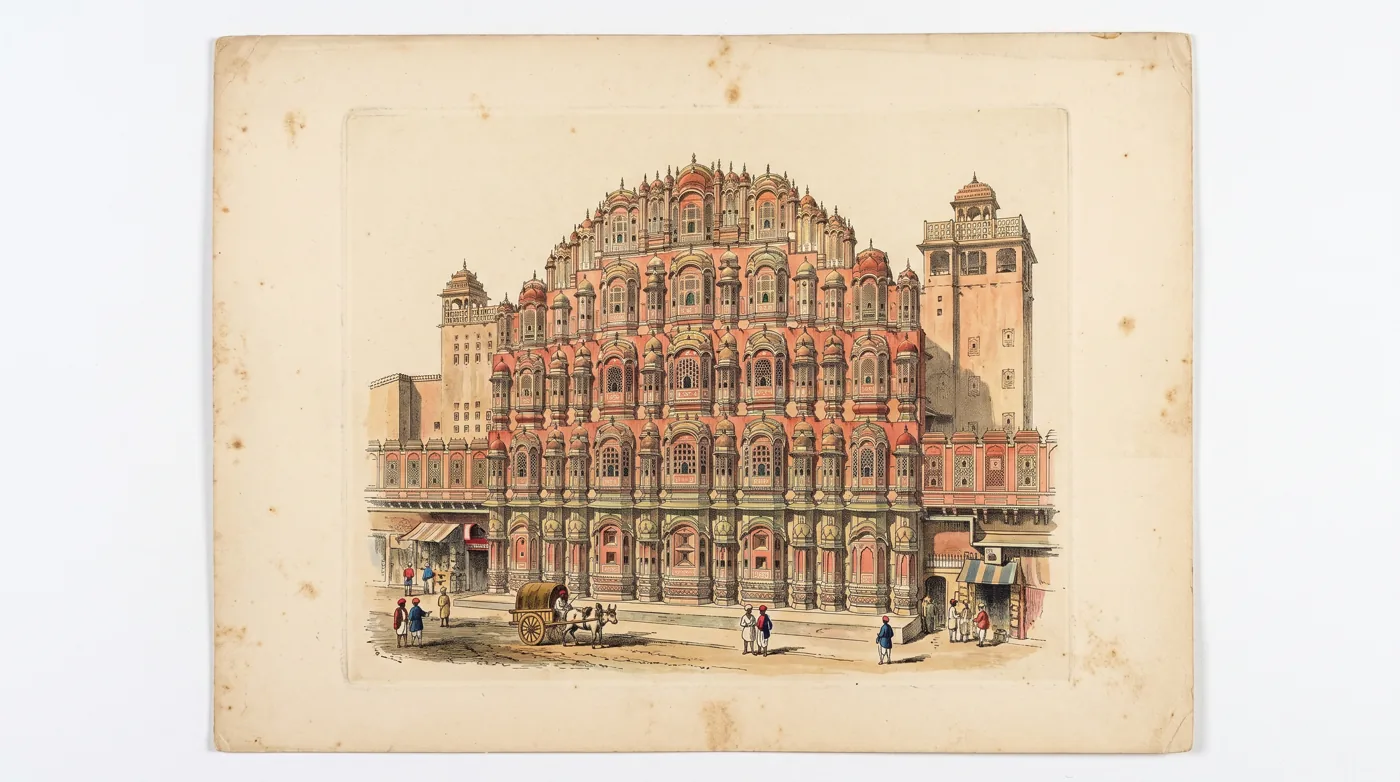
Why a king built a wall of windows
In 1799, Maharaja Sawai Pratap Singh — grandson of Jaipur's founder, on the throne since he was fourteen, and a serious poet and Krishna devotee who wrote under the pen name Brajnidhi — had a problem that was cultural, not architectural. The royal women lived in purdah. They could not be seen in public, could not stand at an open window, could not step onto a balcony over the bazaar. And the bazaar was where everything happened: the processions, the elephants, the festivals, the ordinary theatre of a new city getting on with its day.
So he had his architect, Lal Chand Ustad, build them a machine for looking. Not a room with a view — a whole elevation of views. Nine hundred and fifty-three of them, each one a jharokha with a stone lattice fine enough to see through from the inside and impossible to see through from the street. The women got the city. The city got a facade. Both sides of that bargain are still standing.
The shape, the colour, and the story about Krishna
Stand across the road and look at the outline rather than the windows: it steps inward as it rises, narrowing to a crest — a pyramid, roughly, about 15 metres tall. Pratap Singh was a devotee of Krishna, and the accepted reading is that the profile is meant to resemble Krishna's mukut, his plumed crown. Whether Lal Chand designed it that way or the story attached itself later, nobody can prove. It is a good story and the shape does fit it.
The colour is younger than the building. Hawa Mahal was red and pale sandstone for its first seventy-odd years; the pink arrived in 1876, when Sawai Ram Singh had the entire walled city painted terracotta to welcome the Prince of Wales, and a bye-law has kept it that way ever since. You are looking at a 1799 building wearing an 1876 coat of paint that has now been reapplied for 150 years.
What is actually inside
You enter from the back, and the first thing you find is a courtyard — which surprises people, because from the road the building looks like it has no back. Then you go up. There are no grand staircases; ramps connect most of the floors, built for palanquins and for women in heavy poshak who were not going to climb stone steps. Each level has a name and a purpose, and by the top you are standing above the rooftops of the old city with the Nahargarh ridge in front of you.
The story, in five dates
Sawai Jai Singh II founds Jaipur; the City Palace and its zenana are laid out along what will become Hawa Mahal Road.
Sawai Pratap Singh takes the throne at fourteen — poet, Krishna devotee, and the man who will commission the screen.
Hawa Mahal is completed to Lal Chand Ustad's design, as an extension of the City Palace zenana.
The walled city is painted pink for the Prince of Wales; the facade takes on the colour it still wears.
The first major restoration in decades — stonework, lattices and the coloured glass repaired.
Jaipur's walled city is inscribed by UNESCO as a World Heritage Site; Hawa Mahal is its signature landmark.
Inside Hawa Mahal — what to see, in order
The facade — the thing you came for
Five storeys of jharokhas rising in a stepped pyramid over Hawa Mahal Road, in red and pink sandstone, crowned with domed chhatris and fretwork so fine it reads as lace from across the street. It faces east, straight into the sunrise. This elevation is the entire point of the building — everything behind it exists to hold it up.
The 953 jharokhas
Each window is a small projecting balcony with a carved stone jali screen and a curved bangaldar roof. The count — 953 — is the number quoted on every signboard, and while nobody re-counts it annually, the density is real: from inside, the wall is more hole than stone. The lattice geometry does the work. Light and air pass; sightlines from the street do not.
Sharad Mandir — first floor
Named for Sharad Purnima, the autumn full-moon festival, and used as the hall for those celebrations. A wide chamber with the first proper run of jharokhas along the street side. The stone here has the softest wear — two centuries of hands on the sills.
Ratan Mandir — second floor
The ratan (jewel) floor, worked with coloured glass in the panes and inlay in the walls. This is the one that photographs indoors: morning sun through the red, green and amber glass throws pools of colour across the stone floor and up the walls.
Vichitra Mandir — third floor
The most personal room in the building. Vichitra means singular or curious, and this was Pratap Singh's own retreat — where the maharaja worshipped Krishna and wrote his poetry as Brajnidhi. A king who built a screen for the women of his household kept one small chamber inside it for himself.
Prakash Mandir — fourth floor
Prakash means light, and this is the floor that gets it — an open terrace on both sides rather than a walled chamber, so the building finally breathes. You get city rooftops in one direction and the courtyard drop in the other.
Hawa Mandir — the top floor
The summit, and the smallest room, right below the crest of the pyramid. The wind is genuinely stronger up here — the whole facade funnels it — and the view opens up: the domes of the City Palace behind you, Jantar Mantar's instruments, the old city rooftops, and Nahargarh Fort on the ridge beyond.
The archaeological museum
A small museum off the ground-floor courtyard, holding miniature paintings, ceremonial armour, coins and household objects from the Jaipur court. It is included in your ticket — no separate charge — and it is quiet, because approximately nobody goes in.
The rear courtyard
Where you actually enter: an open court with a fountain, flanked by two-storey buildings, with the back of the great facade rising in front of you. From here you finally see the truth of the place — the screen is thin, propped and braced, more stage set than palace.
Hawa Mahal ticket prices 2026
Prices are the current published rates and get revised from time to time — treat them as a guide and confirm at the counter. Student concessions exist with valid ID; ask, because they are not always advertised. Two practical notes: the composite ticket is worth buying here if Hawa Mahal is your first stop, because this counter almost never has a queue while Amber's does; and note that Hawa Mahal is the cheapest ticket on the composite list, so buying the composite at Amber and working backwards costs you nothing either way.
How to reach Hawa Mahal
On foot (best)
Hawa Mahal sits on Hawa Mahal Road between Badi Chaupar and Chhoti Chaupar, in the heart of the walled city. It is a 5-minute walk from City Palace, 5 minutes from Jantar Mantar and about 3 minutes from the top of Johari Bazaar. If you are doing the old city, you will walk to it whether you planned to or not.
By metro
The Jaipur Metro Pink Line terminates at Badi Chaupar — an underground station roughly 200 metres from the facade. Fares are ₹10–25 from Mansarovar or Civil Lines. It is clean, air-conditioned, and the single most underused way to reach the old city; almost no tourist uses it.
By cab
Any cab reaches it in 10–20 minutes from most of Jaipur, but understand that there is no parking on Hawa Mahal Road. Your driver drops you and circles, or waits at Tripolia. That is normal — do not think he is abandoning you. Our full-day sightseeing cab is ₹1,799 and handles this by design: driver drops at the facade, you cross for the photo, he picks up at the back gate after the museum.
By auto or e-rickshaw
₹80–150 from most of the old city or the railway station if you negotiate before getting in. E-rickshaws swarm Badi Chaupar and are the cheapest way to hop between old-city sights (₹20–30 a shot).
Getting to the entrance from the facade
This trips up almost everyone. From the front, walk to the end of the building and take the lane around the back toward Tripolia Bazaar — the ticket gate is roughly 200 metres and 3 minutes around. There is no door on the famous side. Do not circle the block twice looking for one; people do, every single day.
Where to shoot
- The rooftop cafés directly opposite (Wind View Café, Tattoo Café & Lounge and two or three others in the same block) — the elevated head-on shot everyone knows. Order a coffee, ask for a front-row table, take your time.
- The pavement across the road at 7:30 am — free, empty, and the light is better than it will be at any hour the cafés are busy. The facade faces east; the sun does the work.
- Ratan Mandir, second floor, 9:00–10:15 am — coloured glass throwing red and green light across the stone. Only in that window, only in the morning.
- Looking out through a jharokha — the lattice in silhouette, the bazaar in focus beyond it. The one photo from Hawa Mahal that says something about Hawa Mahal.
- The Prakash Mandir terrace — shoot up the inside face of the facade. Almost nobody points a camera that way.
- Hawa Mandir, the top floor — City Palace domes, Jantar Mantar and the Nahargarh ridge behind them, all in one frame.
- The rear courtyard — the honest shot: the back of the screen, propped and bare. The best photograph nobody takes here.
Honest tips from our drivers & guides
- The entrance is at the back. Say it twice. The famous facade has no public door — you go around the building via the lane toward Tripolia Bazaar. It is 200 metres and three minutes, and not knowing this costs visitors twenty minutes and a lot of goodwill every day of the year.
- The facade faces east, so go at sunrise. 7:30–8:30 am, from the opposite pavement, the sun hits the front square-on and the pink goes gold. From about 1 pm the facade is in its own shade and every photo you take will look flat and grey. This is the difference between the postcard and the disappointment, and it costs nothing.
- A coffee is the price of the shot. The rooftop cafés across the road exist for one reason and they know it. The coffee is average and the food is worse — go for the terrace, not the menu. Ask for a table on the front rail; they do not charge extra for it. If you want an empty rail, be there when they open, around 8:30–9.
- Be honest about the inside. Hawa Mahal is a facade with rooms attached, not a palace, and forty-five minutes covers it. If your day is tight, take the photo from the street for free and put the hour into City Palace or Jantar Mantar five minutes away. We would rather tell you that than watch you feel short-changed at the ticket counter. It is not overrated as a building — it is overrated as an interior.
- Buy the composite ticket here. The ₹300/₹1,000 composite covers eight sites for two days, and Hawa Mahal's counter is the quietest on the list. Buying it here while there is no queue and then walking up to Amber the next morning at 8 saves you the one queue that actually costs you good light.
- Ramps, not stairs — mostly. Most floors connect by gentle ramps built for palanquins, which makes the lower levels manageable for people who struggle with steps. But the last climb to Hawa Mandir is steps, and they are narrow. The stone is polished glassy by two centuries of feet — in leather soles it is genuinely slippery.
- Skip the guide here. This is one of the few Jaipur monuments where you do not need one. It is one building, five floors, one story, and it is all in this page. The men at the gate quoting ₹200–300 will give you fifteen minutes of the 87-degree-no-foundation routine and hand you off to a gem shop. Save the guide money for Amber, where it genuinely buys you something.
- Do not stand on the road divider. Every day someone backs into the middle of Hawa Mahal Road to fit the whole facade in frame. It is a live two-way road with buses. Shoot from the pavement with your back to the shopfronts, or pay for the café terrace — that is what it is there for.
- Go up first, museum on the way out. The good light on the upper floors is gone by 10:30 and the museum will still be there and still be empty. Everyone does it in the wrong order because the museum is at the entrance.
Hawa Mahal — FAQs
What are Hawa Mahal timings?
Hawa Mahal is open 9:00 am to 4:30 pm every day, with last entry around 4:15 pm. It stays open on public holidays. Note that these hours apply only to going inside — the facade itself is on a public road and you can photograph it at any hour, which is exactly what we recommend doing at sunrise, well before the gate opens.
What is the entry fee for Hawa Mahal?
₹50 for Indian visitors and ₹200 for foreign visitors, which includes the small archaeological museum inside. The composite ticket (₹300 Indian / ₹1,000 foreigner) covers Hawa Mahal plus Amber Fort, Jantar Mantar, Albert Hall, Nahargarh, Sisodia Rani ka Bagh, Isarlat and Vidyadhar Bagh, and stays valid for two days — worth it if you are seeing even three of them. Student concessions exist with valid ID; ask at the counter, as they are not always displayed.
Why does Hawa Mahal have 953 windows, and why was it built?
Because the women of the royal household lived in purdah and could not be seen in public — but the street below was where Jaipur's processions, festivals and daily life happened. In 1799, Sawai Pratap Singh had Lal Chand Ustad build them a five-storey screen of 953 jharokhas, each with a stone lattice fine enough to see out of and impossible to see into. The women got a view of the entire city; the city got a wall. The name comes from the other effect: air squeezed through 953 small openings accelerates and cools, so the interiors stay cooler than the street — the Palace of Winds, quite literally.
What is the best time to visit Hawa Mahal for photos?
Early morning, 7:30 to 9:00 am. The facade faces east, so sunrise lights it head-on and turns the pink to gold, and the road is quiet enough to shoot from the pavement. By early afternoon the sun has crossed behind the building and the facade sits in its own shade — flat, grey, and the reason so many people's Hawa Mahal photos disappoint them. For the coloured-glass light inside, on Ratan Mandir, you need 9:00–10:15 am and nothing later. Season-wise, October to March is comfortable; April to June the old city is brutal after 10 am.
How long does it take to see Hawa Mahal?
45 minutes to an hour, including the museum. It is a genuinely small building — five floors, each one shallow — and there is no way to spend two hours here honestly. Add 20–30 minutes if you are doing the café photo across the road. In practice, most people combine it with City Palace and Jantar Mantar into one three-to-four-hour old-city morning, which is the right way to do it.
Can you go inside Hawa Mahal?
Yes — you can walk all five storeys, from the courtyard up through Sharad Mandir, Ratan Mandir, Vichitra Mandir and Prakash Mandir to Hawa Mandir at the top, plus the archaeological museum. Adjust your expectations first, though: this is a screen, not a palace. In places it is one room deep. There are no throne rooms or grand halls, and the rooms are mostly bare. What you go inside for is the view out through a jharokha, the coloured light on the second floor and the rooftop panorama from the top — not for furniture.
Where is the entrance to Hawa Mahal?
At the back — not on the famous facade, which has no public door at all. From the front, walk to the end of the building and take the lane around to the rear, toward Tripolia Bazaar; the ticket gate is about 200 metres and three minutes away, opening into a courtyard behind the screen. This catches out more first-time visitors than anything else in Jaipur. If you are circling the block hunting for a grand entrance under the windows, stop — there isn't one and there never was.
Is Hawa Mahal worth visiting?
The facade, absolutely — it is the most recognisable building in Rajasthan and it is free to stand and look at. The interior, honestly, is a maybe. If you like understanding why a building exists, the hour inside is excellent: the jharokha view, the ramps built for palanquins, the bare back of the screen in the courtyard. If you are expecting a palace because of the name, you will be out in twenty minutes feeling cheated. Our advice to guests on a tight day: take the photo from the street at sunrise for free, and spend the ticket hour at City Palace or Jantar Mantar instead — both are five minutes away and both reward more time. On a two-day Jaipur trip, go in.
Which café has the best view of Hawa Mahal?
The rooftop cafés directly across Hawa Mahal Road — Wind View Café and Tattoo Café & Lounge are the two best known, with a few smaller terraces in the same block that look out on exactly the same thing from a few metres left or right. All of them give you the elevated head-on view; none of them are worth going to for the food. Order a coffee, ask for a table on the front rail, and go around 8:30–9 am when they open, for the light and the empty rail both. Later in the day you may queue for a seat.
How do I get to Hawa Mahal from the railway station or airport?
From Jaipur Junction it is about 4 km — 15 minutes by cab, ₹100–150 by auto, or take the Pink Line metro to Badi Chaupar station, 200 metres from the facade. From Jaipur airport it is 12 km, about 30 minutes. Bear in mind there is no parking on Hawa Mahal Road itself, so a cab will drop you and wait near Tripolia — our tour packages and ₹1,799 sightseeing day both build the old-city walk around that.
What else is close by
City Palace
5 min walk
The palace Hawa Mahal is physically attached to — the royal family still lives in the Chandra Mahal. Peacock Gate, the armoury and the textile museum. Your ticket here also covers Jaigarh Fort for two days.
Jantar Mantar
5 min walk
Sawai Jai Singh II's UNESCO-listed observatory of giant stone instruments, including the world's largest sundial — accurate to two seconds. Covered by the composite ticket.
Johari Bazaar
3 min walk
The jewellers' bazaar running south from Badi Chaupar — kundan-meena, gemstones, and Jaipur's best-known lehenga shops. Also where you eat: Rawat's kachori and LMB are both on this stretch.
Tripolia Bazaar
2 min walk (behind the monument)
The lane you walk through to reach Hawa Mahal's actual entrance — lac bangles, brassware and ironmongery, and considerably more real Jaipur than the tourist stretch out front.
Albert Hall Museum
10 min drive
The Indo-Saracenic museum in Ram Niwas Garden, floodlit gold at night and swarming with pigeons at dusk. Rajasthan's oldest museum; covered by the composite ticket.
Patrika Gate
20 min drive
The painted gate at Jawahar Circle — not historic (built 2016) and utterly unashamed about it. The most photographed non-monument in Jaipur. Free, and best before 8 am.

Seeing Hawa Mahal tomorrow?
One car, one driver, the whole Pink City in a day — starting here at 8 am, before the buses.