City Palace, Jaipur — The Complete Visitor's Guide
The only palace on your Jaipur list where the family that built it is still upstairs. Here is what is actually inside, what the ticket really covers, and which parts are worth your ninety minutes — from people who drop guests at the Virendra Pol every week.
City Palace is the royal residence at the centre of Jaipur's walled old city, begun by Sawai Jai Singh II between 1727 and 1732 when he founded the city itself. It mixes Rajput, Mughal and European architecture, and part of it is a museum — but the Chandra Mahal, the seven-storey block at its heart, is still the private home of the Jaipur royal family, which makes it a rare thing: a working palace, not a ruin.
- Timings: 9:30 am – 5:00 pm daily, with a separate night visit roughly 7:00 – 10:00 pm.
- Entry: ₹200 for Indians, ₹700 for foreigners. The royal-quarters (Chandra Mahal) tour starts around ₹1,500 extra.
- Time needed: 1.5–2 hours for the museum courtyards at a fair pace.
- The ticket quietly includes Jaigarh Fort for 2 days — keep the stub. Almost nobody knows this.
- Not covered by the ₹300/₹1,000 composite ticket (that one covers Amber, Jantar Mantar, Hawa Mahal, Albert Hall and Nahargarh, but never this).
- Don't miss: the two silver urns in the Diwan-i-Khas — the largest silver objects in the world — and the Peacock Gate in Pritam Niwas Chowk.
City Palace confuses people, and the confusion is understandable: half of it is a museum you can walk through, and half of it is somebody's house. The royal family still lives here — in the Chandra Mahal, the seven-storey block you can see but mostly cannot enter — which is why the place feels less like a monument and more like a very grand address that tolerates visitors. That single fact changes how you should read it. Nothing here is preserved as a ruin; it is maintained because someone is upstairs. The palace is also smaller than the ticket price suggests, and we will be honest about that. You are not paying for acreage. You are paying for four courtyards of genuinely first-rate objects — two silver urns nobody can quite believe, four painted gates worth the trip on their own — and for the odd privilege of standing in the courtyard of a house that has been continuously occupied by the same family for three hundred years.
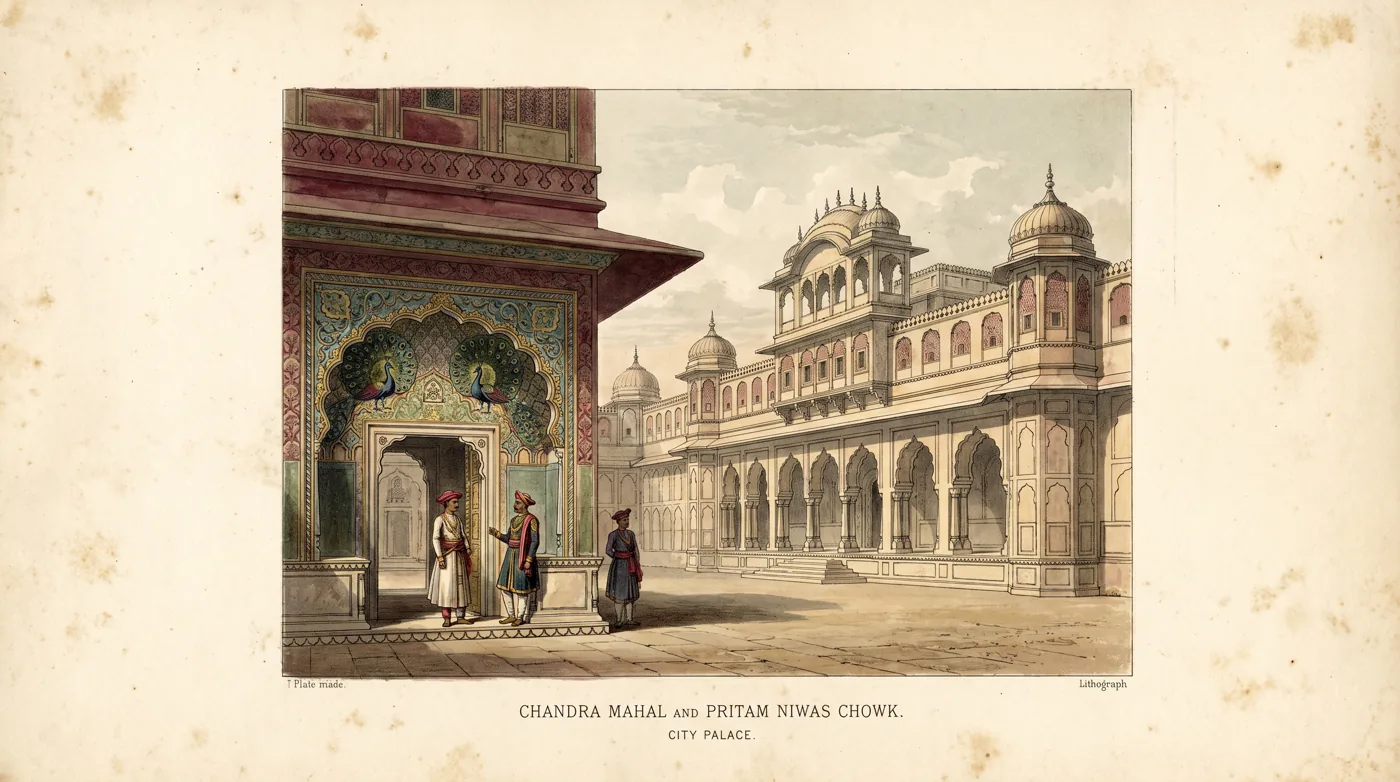
Heritage plates
Hand-coloured artwork commissioned for this guide, in the style of the 19th-century travel plates that first carried City Palace to the world.
Why the palace is here — and why the city is around it
In 1727, Sawai Jai Singh II did something almost nobody in his position did: he walked away from a perfectly good fort. Amber had served the Kachwahas for 150 years, but it was cramped in a valley, short of water, and impossible to grow. So he came 11 km south and built a city from nothing — a planned grid of nine rectangular blocks, laid out on the principles of the Vastu Shastra, with the palace occupying the two central blocks. Everything you walk in the old city radiates outward from this building. The palace was not dropped into Jaipur; Jaipur was drawn around the palace.
The main construction ran from about 1727 to 1732, and every ruler since has added a wing, a gate or a gallery — which is exactly why the styles argue with each other. Jai Singh's chief architect Vidyadhar Bhattacharya set the plan and the Rajput–Mughal bones. Nearly two centuries later, Sir Samuel Swinton Jacob, a British engineer with a real feel for Indian craft, added the Mubarak Mahal for Madho Singh II. Look at the two buildings side by side and you can date the empire's mood: Mughal arches giving way to Victorian symmetry, and neither one apologising.
How the palace is laid out
You enter through the Virendra Pol (or the Udai Pol, if your driver knows the traffic), buy the ticket, and immediately meet the Mubarak Mahal sitting alone in a courtyard like a marble paperweight. From there it is a loop: Mubarak Mahal, then the armoury, then out to the Diwan-i-Khas and its urns, then the Diwan-i-Aam art gallery, then through the arch into Pritam Niwas Chowk for the four gates, with the Chandra Mahal rising behind them. It is compact. You can do it in ninety minutes without rushing, and the mistake most people make is not that they hurry — it is that they walk past three of the four gates while photographing the fourth.
The story, in five dates
Sawai Jai Singh II abandons Amber, founds Jaipur, and lays the palace at the centre of his new grid — Vidyadhar Bhattacharya drawing the plan.
The core of the palace — Chandra Mahal and the main courtyards — is substantially complete.
Sawai Ram Singh II paints the old city pink for the Prince of Wales; the palace goes with it, and the colour never leaves.
Madho Singh II adds the Mubarak Mahal as a guest reception house, designed by Sir Samuel Swinton Jacob.
Madho Singh II sails to Edward VII's coronation with the two giant silver urns of Ganga water — still the largest silver objects on earth.
Man Singh II opens part of the palace as the Maharaja Sawai Man Singh II Museum; the family stays on in the Chandra Mahal, where they remain today.
Inside City Palace — what to see, in order
Mubarak Mahal — the 'Welcome Palace' and the textile museum
The first thing you see: a delicate marble-and-sandstone pavilion floating in the middle of the first courtyard, built around 1900 by Madho Singh II as a reception house for visiting dignitaries and designed by Samuel Swinton Jacob. Today it holds the textile and costume collection — Benares silks, pashmina, block-printed and gold-worked royal dress, the sort of fabric that makes you understand why Rajasthan traded with the whole world.
Diwan-i-Khas — the two silver urns
The Hall of Private Audience: an open marble pavilion where the king met his nobles, and the single most remarkable object in Jaipur sits at either end of it. The two Gangajali urns are the largest silver objects in the world — Guinness-certified — each about 1.6 metres tall, holding roughly 4,000 litres, hammered from some 14,000 melted silver coins with no soldering anywhere. The reason they exist is better than the record: Madho Singh II sailed to England in 1902 for Edward VII's coronation, was devout enough that he would not drink English water, and had these made to carry Ganga water with him across the sea.
Diwan-i-Aam / Sabha Niwas — the art gallery
The Hall of Public Audience, now the palace's picture gallery, and the room that rewards slowing down. Under some of the largest chandeliers in India you get Mughal and Rajasthani miniatures, illuminated manuscripts, a Persian carpet collection, and painted ceilings in mineral colours that have not needed retouching in a very long time.
Pritam Niwas Chowk — the four painted gates
The reason your photo roll fills up. This small inner courtyard — sometimes signed Pitam Niwas — is the last stop before the private residence, and its four doorways are each painted for a season and a deity. Together they are, honestly, the most beautiful thing inside City Palace: Peacock Gate (autumn, Vishnu) with five modelled peacocks fanned across the arch and the famous one on every Jaipur postcard; Lotus Gate (summer, Shiva–Parvati), petals in blue and green stacked up the frame; Green Gate or Leheriya Gate (spring, Ganesha), the wave-pattern one in cool green; and Rose Gate (winter, Devi), covered in repeating rose rosettes.
Chandra Mahal — the part they still live in
The seven-storey tower at the heart of the complex, and the actual home of the Jaipur royal family — which is why your general ticket gets you the ground floor and a long look upward, and no further. Each floor has its own name and character (Sukh Niwas, Rang Mandir, Chhavi Niwas, Shri Niwas, the Mukut Mandir crown on top), and the blue-and-white Chhavi Niwas in particular is a genuinely famous room. The separate royal-quarters tour — from about ₹1,500 — takes you up through the private floors with a palace guide and onto the terrace.
Baggi Khana — the carriage museum
The old coach house, off to the side, holding the family's fleet: palanquins, ceremonial baggis, an English chariot and the Victoria Baggi presented by the Prince of Wales. There is also the Thakurji ki Baggi, built to carry the deity in procession, and a European-style carriage that is oddly moving in its out-of-placeness.
Maharani Palace — the armoury
Once the queens' quarters, now the arms and armour gallery, and one of the better weapons collections in India: jewelled and damascened swords, a scissor-action katar that opens inside the wound, muskets, chainmail, and a few pieces with a documented owner and a documented battle. The painted ceiling of the original zenana chamber survives above it all.
City Palace ticket prices 2026
Prices are the current published rates and get revised from time to time — treat them as a guide and confirm at the counter. Two things worth knowing before you pay: your City Palace ticket covers Jaigarh Fort for two days, which is a real saving if you are doing Amber; and the Jaipur composite ticket does not work here, so do not turn up waving one and expect to walk in.
How to reach City Palace
By cab (recommended)
The palace sits in the heart of the walled city — about 5 km and 20 minutes from Jaipur Junction, less from most old-city hotels. The catch is parking: the lanes around Tripolia Bazaar are tight and one-way, so a driver who can drop at the Virendra Pol and re-appear at the exit saves you a genuinely annoying twenty minutes. Our full-day sightseeing cab is ₹1,799 and pairs this with Jantar Mantar next door by design.
On foot, from Hawa Mahal
A 10-minute walk through Tripolia Bazaar — and the best way to arrive, because you get the old city on the way in. Hawa Mahal, City Palace and Jantar Mantar are a single walkable cluster; treat them as one morning, not three stops.
By metro
Chandpole station on the Pink Line is about a 15-minute walk away, and it is a clean, cheap, air-conditioned way into the old city that visitors almost never use. Underrated in May and June.
By auto-rickshaw
₹100–150 from most central points if you agree the fare first. Fine and fast. The drop is at the gate; the negotiation is the only friction.
Where to shoot
- The Peacock Gate, Pritam Niwas Chowk — the shot you came for. Arrive at 9:30 or after 4:30; the middle of the day is a queue of people taking turns in the doorway.
- The Rose Gate — same courtyard, no line, and the winter-rose rosettes take late-afternoon light better than the peacocks do.
- Mubarak Mahal from the courtyard corner — shoot it at an angle rather than head-on and the marble screens read as lacework.
- Chandra Mahal rising behind the gates — stand at the back of Pritam Niwas Chowk and frame a painted gate in the foreground with all seven storeys above it. That single frame is the whole palace.
- The silver urns in the Diwan-i-Khas — get a person in the frame for scale, or nobody believes the size.
- The rooftops from the Chandra Mahal terrace — royal-quarters tour only, and the reason to pay for it: the Jai Singh grid laid out below you.
Honest tips from our drivers & guides
- Your ticket includes Jaigarh Fort for two days. This is the tip nobody tells you and the counter will not volunteer it. Jaigarh sits above Amber and holds the Jaivana, the largest wheeled cannon ever built. Keep the stub in your wallet — most visitors pay a second time up the hill or skip the fort entirely. See our Amber Fort guide for how to sequence the two.
- The composite ticket does not work here. The ₹300/₹1,000 pass covers eight sites and this is not one of them. People find this out at the gate, argue for five minutes, and lose.
- Do Jantar Mantar in the same ticket window. It is literally next door, and the observatory is the one monument in Jaipur where we tell guests to spend money on a guide — without one it is a garden of odd stone wedges; with one it is the cleverest thing you will see all week.
- Govind Dev Ji is inside the complex and it is free. The palace's own Krishna temple, in the Jai Niwas garden, is Jaipur's most loved place of worship — and you can walk into it without a museum ticket, from the Jaleb Chowk side. Time it with an aarti or you will find the deity curtained off.
- Come at 9:30 or at 4:00, not at noon. The palace is compact and the courtyards are open — midday is hot, crowded and flat-lit. The last ninety minutes of the day give you the honey light on pink plaster that everyone comes for.
- Guides at the gate ask ₹400–600. A decent one is worth it here, because the objects have stories and the placards mostly do not. Agree the price and route before you start, and say plainly that you do not want a jewellery-shop stop — the palace exit funnels into a gem showroom circuit and the commission is roughly a third.
- Photography inside the galleries is restricted and staff enforce it properly. Courtyards and gates are fine. There is a separate camera fee for some sections — ask at the counter rather than being asked to delete.
- Do not buy the 'palace' souvenirs at the exit. The same textiles are a third of the price in Johari Bazaar, six minutes' walk away, and the block-printing there is real.
City Palace — FAQs
What are City Palace Jaipur timings?
City Palace is open 9:30 am to 5:00 pm every day, with last entry around 4:30 pm. There is a separate night visit, roughly 7:00 to 10:00 pm, when the courtyards are floodlit — atmospheric, though the galleries are limited or closed and you are paying mainly for the lighting. The palace stays open on public holidays.
What is the entry fee for City Palace Jaipur?
₹200 for Indian visitors and ₹700 for foreign visitors for the museum. The royal-quarters (Chandra Mahal) tour is extra, from about ₹1,500, and takes you into the family's private floors with a palace guide. Student rates are available with a valid physical ID. Note that the ₹300/₹1,000 Jaipur composite ticket does not cover City Palace — but your City Palace ticket does cover Jaigarh Fort for two days.
Does the royal family still live in City Palace?
Yes. The Jaipur royal family still occupies the Chandra Mahal, the seven-storey block at the centre of the complex — it is a private residence, which is why the general ticket only gets you the ground floor. Look up at the roof: a flag flies when the Maharaja is in residence and comes down when he leaves. India abolished the official titles in 1971, but the family, the house and the custom all carried on. It is the main thing that separates this from every other palace on your list — the place is lived in, not preserved.
What are the silver urns at City Palace?
They are the two largest silver objects in the world — Guinness-certified — standing in the Diwan-i-Khas. Each is about 1.6 m tall, holds roughly 4,000 litres, and was hammered out of some 14,000 melted silver coins with no soldering at all. They were made for Madho Singh II, who sailed to England in 1902 for Edward VII's coronation and was devout enough that he would not drink English water — so he carried Ganga water across the sea in them. They are known as the Gangajali.
What are the four gates at City Palace?
In Pritam Niwas Chowk, the last courtyard before the royal residence, four doorways are each painted for a season and a deity: the Peacock Gate (autumn, Vishnu) with its modelled peacocks — the famous one; the Lotus Gate (summer, Shiva–Parvati); the Green or Leheriya Gate (spring, Ganesha); and the Rose Gate (winter, Devi). Almost everyone photographs the Peacock Gate and walks out. Do the full square — the other three are just as good and completely empty, and the Rose Gate is the better shot in late-afternoon light.
How much time do you need at City Palace?
1.5 to 2 hours covers the museum courtyards properly — Mubarak Mahal, the armoury, the urns, the art gallery and the four gates. Add 45 minutes to an hour if you take the Chandra Mahal royal-quarters tour. Since Jantar Mantar is next door and Hawa Mahal is a ten-minute walk, the sensible unit is a half day for all three rather than a rushed hour here — which is exactly how our Jaipur tour packages block out the old city.
Is the Chandra Mahal royal-quarters tour worth it?
It depends on you, and we will not pretend otherwise. Worth it if you have palace fatigue and want rooms that are not roped off — you get the private floors, a palace guide who actually knows the family history, and a terrace view over Jai Singh's grid that explains the entire city plan in one glance. Skip it if Jaipur is a one-day stop and this is your third palace since breakfast; put the ₹1,500 into a proper guide for Jantar Mantar next door, which needs one far more than this does.
Does the City Palace ticket include Jaigarh Fort?
Yes — for two days, and it is the best-kept secret on any Jaipur ticket. Jaigarh sits on the ridge directly above Amber Fort and holds the Jaivana, the largest wheeled cannon ever built. Keep your City Palace stub and show it at the Jaigarh gate. Most visitors either pay a second time or skip Jaigarh entirely without ever knowing they had already bought it. If you are doing Amber Fort, plan City Palace within the two days either side.
Is City Palace covered by the Jaipur composite ticket?
No. The composite ticket (₹300 Indian / ₹1,000 foreigner) covers Amber Fort, Jantar Mantar, Hawa Mahal, Albert Hall, Nahargarh, Sisodia Rani ka Bagh, Isarlat and Vidyadhar Bagh for two days — City Palace is not on that list, because it is run by the royal family's own trust rather than the state archaeology department. You buy this one separately. The upside is the reverse deal: this ticket covers Jaigarh, which the composite does not. See all 30 Jaipur tourist places for how the tickets stack up.
What else is close by
Jantar Mantar
2 min walk — next door
Jai Singh II's UNESCO-listed stone observatory, still accurate to about two seconds. The one monument in Jaipur where we tell guests to pay for the guide.
Hawa Mahal
10 min walk
The 1799 palace of winds and its 953 windows. The entrance is from the back lane, not the famous facade — there is no front door.
Govind Dev Ji Temple
Inside the complex
Jaipur's most loved temple, in the palace's own Jai Niwas garden. Free, no museum ticket needed, and best timed with one of the seven daily aartis.
Johari Bazaar
6 min walk
The old city's jewellery and textile street — kundan-meena, gemstones and block print. The same souvenirs the palace exit sells, at a third of the price.
Jaigarh Fort
30 min drive
The armoury fort above Amber with the Jaivana cannon. Free with your City Palace ticket for 2 days, which is why you keep the stub.
Seeing City Palace tomorrow?
One car, one driver, the whole Pink City in a day — starting here at 8 am, before the buses.